
Plantar Fasciitis
Treatment in Pittsburgh
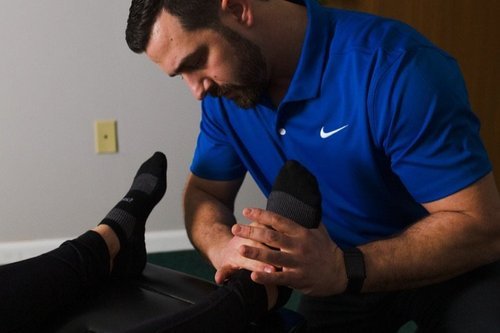
What causes plantar fasciitis and does it
go away on its own?
Plantar fasciitis is caused by chronic overload of the plantar fascia, the thick band of tissue along the bottom of the foot, usually driven by restricted ankle mobility, weakened arch muscles, and poor foot mechanics during walking and training. It rarely resolves fully on its own without addressing those underlying drivers. Rest reduces the irritation temporarily, but the mechanics that caused it remain, and the pain returns as soon as normal activity resumes.
That first step out of bed in the morning. The sharp, knife-like pain in the heel that makes you hobble to the bathroom before your foot loosens up. The ache along the arch that builds through a long day on your feet. The Achilles region that feels tight no matter how much you stretch it.
If this sounds familiar, you have probably already tried rest, ice, stretching your calf, and maybe a pair of orthotics or a heel lift that your podiatrist or someone at a running store recommended. And you are probably still dealing with the same pain on the same schedule.
At New Edge Spine and Sport in Pittsburgh, we treat plantar fasciitis differently. And we have a strong opinion about orthotics.
Why Orthotics Are Not the Answer
This is worth saying directly because most plantar fasciitis patients have already been pointed toward custom orthotics or heel lifts as the solution.
Orthotics do not fix plantar fasciitis. They redistribute the load so the painful structure is less irritated while you are wearing them. The moment you take them off, your foot is in exactly the same mechanical situation it was before. You have not fixed anything. You have created a dependency.
The foot is designed to be strong, mobile, and self-supporting. The arch is not a structure that needs to be propped up from the outside. It is a dynamic system of muscles, tendons, and joints that is supposed to generate and absorb force on its own. When it stops doing that job efficiently, the plantar fascia takes on load it was never designed to handle and breaks down under the repetition.
The goal of treatment is to restore what the foot is supposed to do, not give it a crutch that lets it avoid doing it indefinitely.
What We Do Differently
Assessment at New Edge Spine and Sport starts with understanding why your foot stopped functioning correctly in the first place. That means evaluating ankle dorsiflexion, arch muscle strength, foot mechanics during gait, and how load is being distributed through the lower extremity during movement.
Restricted ankle dorsiflexion is one of the most common drivers of plantar fasciitis that gets completely missed when treatment focuses only on the heel. When the ankle cannot move through its full range, the foot compensates on every step. That compensation loads the plantar fascia thousands of times per day.
Treatment addresses the joint restriction, restores ankle mobility, and progressively rebuilds the arch strength and foot stability that takes chronic overload off the fascia. The goal is a foot that works the way it is supposed to, under any footwear, without needing support to get through the day.
Your visits are one full hour with Dr. Ben. One on one, no generic protocols.
What Patients Tell Us When They First Come In
The first steps in the morning feel like someone is stabbing my heel.
It loosens up after I walk around for a bit but comes back after I sit for a while.
My arch aches by the end of the day especially when I am on my feet a lot.
I have been wearing orthotics for two years and my foot still hurts.
I was told to stretch my calf and rest it and it comes back every time I start running again.
That last pattern is the most common one we see. The calf stretch and rest cycle manages the flare but never addresses the ankle mobility restriction or the arch weakness underneath it. If your plantar fasciitis keeps coming back every time you ramp up activity, the mechanics have not been fixed.
Who We See
New Edge Spine and Sport treats plantar fasciitis throughout Pittsburgh and the South Hills, including Bethel Park, West Mifflin, Pleasant Hills, and Baldwin. Runners, lifters, coaches, and anyone who spends long days on their feet and is tired of being told to rest and stretch.
If you have been managing this for months and want it actually fixed, this is worth a conversation.